The Price of Freedom: Or Freezing Your Balls Off in a German Forest
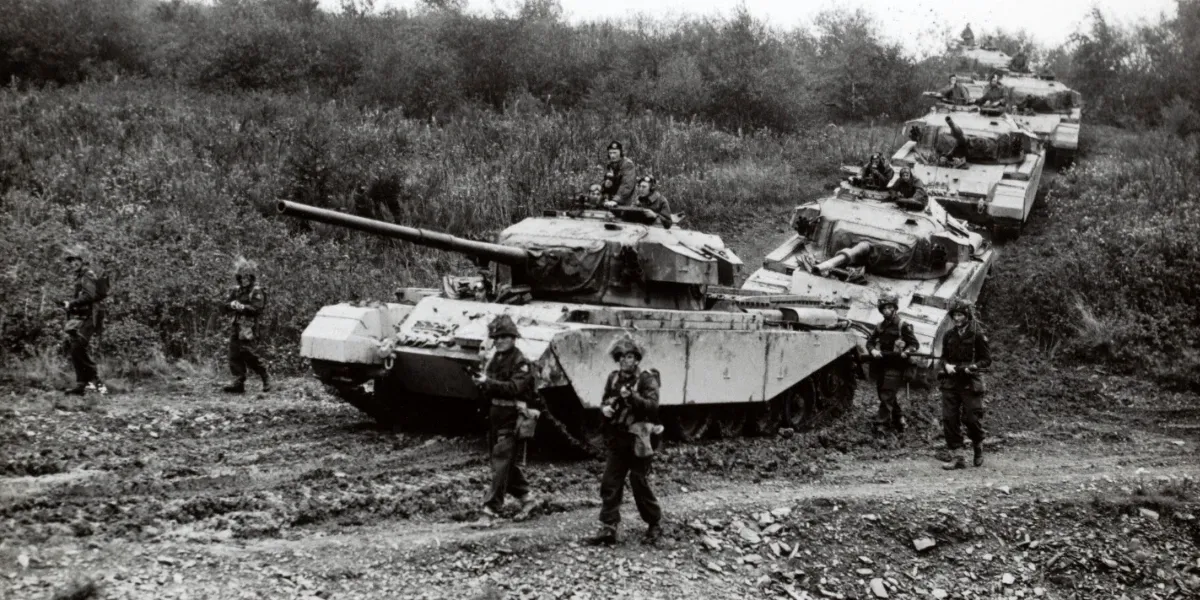
At 1 Armoured Division HQ and Signal Regiment in 1972, our lives revolved around the next exercise.
Exercises normally lasted two or three weeks, and the scenario, from what little I was told or understood, always went something like this:
The Soviets mass on the border.
We deploy to our wartime positions.
The Soviets invade.
We move around a lot, mostly in retreat.
To stop the Soviet advance, NATO uses a tactical nuclear weapon.
We all go back to barracks.
Nobody ever told us what happened after NATO dropped the tactical nuke.
In the real world, it would probably have meant Armageddon. Everyone dying in a bright blinding light, from radiation sickness, or from starvation during the nuclear winter that followed.
In the exercise, however, it meant packing up, returning to Verden, cleaning the Land Rovers, getting the kit repaired, and doing the whole thing again a few weeks later.
The initial excitement about saving the free world quickly became a tedious slog.
Life in the Field
The main thing I remember about being on exercise was that I was always tired, cold, and often wet.
There were normally three of us on a crew: an NCO and two signalmen. We worked shifts on the radio, usually four hours on and eight hours off. During the “off” time, you had to eat, sleep, clean up, and sometimes get lumbered with two hours of guard duty, depending on where we were.
Sleep was often interrupted by moves.
Sometimes we had prior notice. Often, though, they would declare a crash move, which meant we had to pack up very quickly. In theory, this was to keep us mobile, alert, and ready for war.
In practice, it meant everything was dumped into the trailer or the back of the Land Rover in a desperate heap. Then, at the next location, we would spend a couple of hours trying to turn the heap back into something resembling a functioning signals detachment.
This was called training.
The Technology: Larkspur Radio Systems
If you are not interested in old Army radio sets, you may safely skip the next few paragraphs. Nothing explodes, nobody gets promoted, and the plot does not suffer.
The radio sets we used were part of the Larkspur range, designed in the 1940s and introduced into service after the war. By the time I was using them in Germany, they already felt ancient, though to be fair, so did most Army equipment once it had been painted green and handed to a private soldier.
Our detachment used C11 High Frequency sets and C42 and C45 vehicle sets. The C11 was mainly used on command networks and could transmit both voice and continuous wave, which meant Morse code. That was where telegraphists like me came in.
The C11 operated in the HF band, roughly 2 to 16 MHz, and could manage voice over shorter distances and Morse over longer ones, at least under favourable conditions. Favourable conditions, in the Army, were things you mostly heard about rather than experienced.
The C42 and C45 were vehicle sets, used for VHF and high-HF communications. They lived in Land Rovers and armoured vehicles, came with various boxes, amplifiers, power supplies, tuning units, cables, aerials, connectors, and enough opportunities for something not to work properly that they may have been designed by men who believed inconvenience built character.
I have had to look up most of the technical details since, because after fifty years my memory of the equipment is less precise than my memory of being cold, wet, tired, and annoyed.
What I do remember clearly is that the sets were heavy, awkward, temperamental, and absolutely central to what we were supposed to be doing. Without communications, an armoured division becomes a large collection of lost vehicles arguing with maps.
The Reality Check
Moving about, and everything it entailed, was a complete pain in the arse.
The exercises were just games really, much bigger and more expensive versions of the battles we had fought over the Bank on Wern Fawr Road, the woods and orchard in Blaenymaes, or the waste ground behind my Nan’s house.
Perhaps it could be argued that the NATO war games were more realistic than our childhood battles, but I’m not so sure.
In our fertile minds at ten years old, we were actually fighting the war. We were completely invested in victory or defeat. Sticks became rifles. Stones became grenades. The Bank became contested territory. The woods became enemy ground. Nobody needed a briefing from headquarters. We knew who the enemy was because he was the boy from three streets over who had called you a name the previous week.
Of course, the main advantage I had when fighting battles at home was that when it got cold, I could nip back to my Nan’s and sit by the fire for a bit.
No such luxury existed when you were defending the free world in a German forest at minus ten degrees.
On exercise, the cold got into everything. Your boots. Your hands. Your sleeping bag. Your food. Your temper. You could be wrapped in Army-issue kit, sitting in or near a Land Rover full of radio equipment, theoretically part of a vast military machine designed to stop the Warsaw Pact crossing into Western Europe, and still mostly be thinking about your feet.
That is the bit the grand historical summaries tend to leave out.
They talk about NATO doctrine, deterrence, armoured formations, tactical nuclear weapons, forward defence, and the balance of power in Europe.
They do not usually mention the private soldier lying in a damp sleeping bag, wondering whether his socks will ever dry and whether civilisation could perhaps defend itself indoors for once.
The price of freedom, it turned out, was mostly being permanently cold, wet, and tired while playing elaborate games of soldiers with very expensive toys.